
Sober Living Homes: What They Are & How to Choose One

A sober living home is a substance-free shared residence where people can build stability, routines, and supportive relationships during recovery. It can provide a practical bridge between structured addiction treatment and fully independent living, although residents may also enter from outpatient care, another housing program, or the community.
Quality and oversight vary considerably. Some homes are peer-run, while others employ house managers or provide structured recovery support. Understanding the home’s role, rules, costs, staffing, and safety procedures can help you choose an environment that matches your needs rather than simply selecting the nearest available bed.
What sober living is, and how it differs from rehab or a halfway house
Sober living homes, sober homes, and recovery residences are overlapping terms for alcohol- and illicit-drug-free shared housing. The National Alliance for Recovery Residences describes these environments as using a social model: residents support one another, practise everyday recovery skills, and share responsibility for maintaining a healthy home. NARR separates recovery residences into peer-run, monitored, supervised, and clinical models according to staffing and support intensity.
A conventional sober living home is not necessarily a treatment facility. It may provide accountability, peer support, life-skills assistance, and links to community services without delivering medical detoxification, psychiatric care, or formal therapy. Someone who needs clinical treatment can review What Is Rehab? A Complete Guide to Addiction Treatment and the Levels of Care in Addiction Treatment: Detox to Aftercare guide before deciding where housing belongs in their care plan.
Rehab
- Provides a defined clinical treatment program
- May include medical, psychiatric, and therapeutic services
- Usually has an assessed level of care and planned treatment period
Sober living
- Primarily provides substance-free housing and peer accountability
- Often supports work, education, outpatient treatment, and independent routines
- May allow an open-ended or flexible stay while residents meet house expectations
Halfway house
- Meaning varies by jurisdiction and operator
- May be time-limited, professionally staffed, or connected with criminal justice requirements
- Can have tighter schedules and mandatory programming than a typical sober living home
Because terminology is inconsistent, a halfway house vs sober living comparison should focus on the actual services and restrictions rather than the name on the building. Ask whether the residence is voluntary or court-linked, whether clinical services are delivered, who supervises residents, and whether there is a fixed discharge date.
Who sober living is for and when to consider it
Recovery housing may be appropriate for someone who is medically stable but would benefit from more structure than their current living situation provides. Common reasons include completing residential treatment, attending an outpatient program, returning to work or education, rebuilding daily living skills, or avoiding a home environment where substances are present. It may also help people who have limited recovery-focused social support.
Timing should be based on an individual assessment rather than a fixed number of days in treatment. The right arrangement depends on withdrawal risk, physical and mental health, medications, relapse history, transportation, work responsibilities, family needs, and the support level available in the home. The guides to How Long Does Rehab Take? 30/60/90-Day Guide and Types of Therapy Used in Addiction Treatment explain why housing and treatment timelines may not be identical.
Sober living is not a substitute for medical withdrawal management
Suddenly stopping heavy alcohol use can cause life-threatening withdrawal, and abruptly stopping or rapidly reducing benzodiazepines can also cause severe reactions, including seizures. Anyone who may be physically dependent should speak with a doctor or qualified admissions team before entering sober living. Call emergency services for seizures, severe confusion, breathing problems, loss of consciousness, or a suspected overdose.
- Consider sober living when the person can participate safely in community life without round-the-clock clinical monitoring.
- Look for a support level that matches current needs; a peer-run home may suit one person, while another may require supervised recovery housing.
- Confirm that outpatient appointments, medication access, employment, transport, and family contact can continue realistically from the proposed location.
- Involve the current clinician or discharge team when there are co-occurring mental health conditions, recent overdose, pregnancy, complex medications, or previous severe withdrawal.
Typical rules and daily structure
Rules are intended to protect a substance-free shared environment, but they should be written, consistently applied, and explained before payment or admission. SAMHSA recommends that recovery homes provide understandable policies, resident expectations, rights, and a grievance process during orientation. A reputable operator should be willing to share these documents in advance.
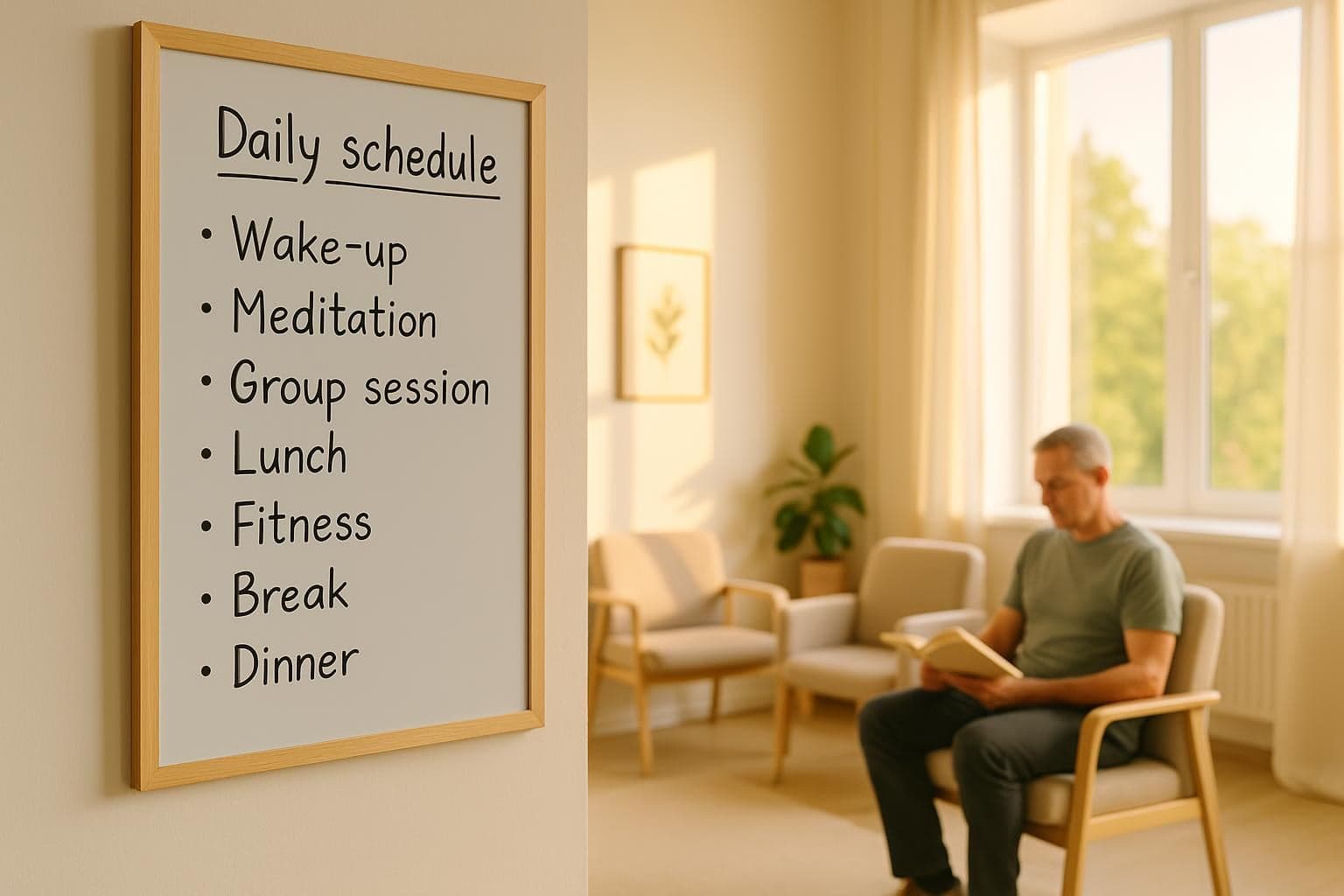
- Remaining free from alcohol, illicit drugs, and other substances prohibited by the written policy
- Participating in alcohol or drug testing under a clearly explained, respectful procedure
- Attending house meetings, recovery activities, outpatient care, or mutual-help meetings when required
- Following curfews, overnight-pass rules, visitor policies, and quiet hours
- Completing household chores and keeping shared spaces safe
- Working, studying, volunteering, seeking employment, or following another agreed daytime plan
- Paying rent or bed fees on schedule and discussing financial problems before arrears accumulate
- Treating other residents respectfully and protecting their privacy
Ask what happens if a resident uses a substance or breaks another rule. Immediate discharge without a safety plan can leave someone vulnerable, particularly after a period of abstinence that may reduce opioid tolerance. The home should be able to explain its response, transport options, emergency contacts, overdose procedures, and referral pathway to a higher Levels of Care in Addiction Treatment: Detox to Aftercare. Medication policies should also be reviewed with a clinician; residents should not change or stop prescribed medication solely to satisfy an informal house demand.
Cost and insurance: what residents usually pay
Sober living is usually paid for as housing rather than billed as inpatient addiction treatment. Fees vary by location, room type, staffing level, meals, transport, and included recovery services. SAMHSA has identified financing as a significant challenge for recovery housing, while federal Medicaid guidance generally excludes room and board outside specified institutional settings. Private plan terms differ, so coverage should always be verified directly.
How common sober living expenses may be handled
| Expense | Common payment approach | What to verify |
|---|---|---|
| Room or bed fee | Usually self-pay on a weekly or monthly basis | Deposit, due dates, refund policy, notice period, and exactly what the fee includes |
| Clinical treatment | May be billed separately to insurance when delivered by a licensed provider | Network status, authorization, deductible, copay, and whether the provider is independent from the home |
| Testing and recovery services | Included by some homes and charged separately by others | Frequency, laboratory used, itemised cost, and whether consent is required |
| Food and transport | May be included, shared by residents, or paid individually | Meal arrangements, grocery expectations, appointment transport, and mileage or ride fees |
| Public or charitable assistance | May be available through grants, local programs, scholarships, or recovery funds | Eligibility, waiting lists, time limits, and whether assistance creates any referral obligation |
Request a written fee schedule before moving in and compare the total monthly cost, not only the advertised bed price. Do not assume that an insurance card makes the housing charge covered. The How Much Does Rehab Cost? Complete Price Guide 2026, Inpatient vs Outpatient Rehab Cost Compared, and Does Insurance Cover Rehab? Complete Guide provide more context on treatment expenses that may sit alongside sober living costs.
How to vet a home: certification, staffing, and safety
Requirements differ across states and localities, and certification is not the same as a healthcare licence. A nonclinical home may not hold a treatment-facility licence, while a residence offering clinical services may be subject to additional rules. SAMHSA recommends recovery housing certification, and NARR affiliates certify homes against standards covering operations, ethics, property, recovery support, and resident protections.
Questions to ask before choosing a sober living home
- Check the relevant state, county, or city agency to learn which licences, registrations, inspections, or certifications apply.
- Verify certification directly with the certifying organisation rather than relying on a logo displayed by the operator.
- Tour the property and inspect bedrooms, bathrooms, exits, smoke and carbon-monoxide alarms, locks, sanitation, and occupancy levels.
- Ask who is present overnight, how house managers are selected, what training they receive, and who supervises them.
- Request the resident agreement, complete fee schedule, refund policy, discharge policy, grievance procedure, and privacy rules.
- Ask how medications are stored and accessed, including prescribed medications for opioid or alcohol use disorder.
- Confirm whether naloxone is available and whether staff and residents are trained to recognise and respond to an opioid overdose.
- Find out which services are provided in-house, which are delivered by external clinicians, and whether residents may choose their own providers.
- Speak privately with current or former residents when possible and ask about rule enforcement, safety, maintenance, and staff conduct.
- Confirm the plan for relapse, psychiatric crisis, medical deterioration, or a resident who needs a higher level of care.
The best match is not always the most restrictive home. It is the one that can safely meet the resident’s present needs while supporting increasing independence. Families comparing options may also use the practical framework in How to Choose a Rehab Center: 10 Questions to Ask or discuss placement with the person’s treatment and admissions teams.
Red flags: patient brokering and unsafe operations
Patient brokering occurs when money, gifts, free rent, or another benefit is exchanged for steering a person to a recovery home, laboratory, or treatment provider. The federal Eliminating Kickbacks in Recovery Act prohibits specified knowing and wilful payments for referrals involving recovery homes and clinical treatment facilities. State laws may add further protections. A legitimate scholarship or transport service should have transparent terms and should not depend on using a particular laboratory or provider.
Be cautious when housing is tied to unexplained testing or treatment
Walk away from pressure to sign blank forms, surrender insurance credentials, attend a particular clinic without a clinical reason, or undergo unusually frequent testing that nobody can explain. Contact the insurer, relevant regulator, certifying body, or a healthcare fraud reporting service if billing or referral arrangements appear suspicious.
- Recruiters offer cash, phones, flights, gifts, or free rent in exchange for admission or insurance information.
- The operator refuses to provide a physical address, tour, written agreement, fee schedule, or proof of applicable certification.
- Residents appear overcrowded, unsupervised, intimidated, or routinely discharged with no safe transition plan.
- Staff confiscate identification, benefit cards, money, or prescribed medication without a lawful and documented reason.
- The home guarantees recovery, advertises implausible success rates, or cannot explain how its claims were calculated.
- Residents are prevented from contacting family, clinicians, advocates, regulators, or emergency services.
- There is no overdose plan, naloxone access, fire-safety information, grievance process, or procedure for urgent medical and psychiatric problems.
- Housing is conditional on using one laboratory, therapist, outpatient program, or transport company, with no transparent clinical or financial explanation.
The term “flophouse” is sometimes used for properties that collect bed fees while providing little safety, accountability, or recovery support. Poor quality should not be confused with modest accommodation: a simple home can still be ethical, clean, well-managed, and supportive. If you are helping someone who feels pressured or unsafe, the guide How to Help a Loved One Get Into Rehab may help you plan a calmer conversation and identify an appropriate next step.
Explore Rehabs by Location
Frequently Asked Questions
There is no universal length of stay. Many sober living arrangements are flexible or open-ended, with residents staying for several months and leaving when they have stable housing, income, support, and a workable continuing-care plan. A recent longitudinal study of sober living residents found that staying for at least six months was associated with better substance-use, psychiatric, and legal outcomes than leaving earlier, although the appropriate duration remains individual. Ask the home whether it imposes minimum or maximum stays and review the plan with the resident’s clinical team.
Related Articles
What to Pack for Rehab: Complete Checklist
Preparing for residential treatment can feel overwhelming, especially when different programs have different rules. A simple rehab packing list can make admission day calmer and he…

How to Stage an Intervention: Step-by-Step Guide
When someone you care about is living with addiction, it is natural to want one conversation that changes everything. An intervention can create an opportunity to accept help, but…

Building or Renovating a Treatment Facility: A Construction Law Primer for Rehab Providers
Opening a new treatment centre, adding a detox wing, or renovating an existing facility all start the same way: with a building contract. For a healthcare-type facility that client…